← All projects
2016 – 2019 FIRST Robotics Competition

FRC — FIRST Robotics Competition

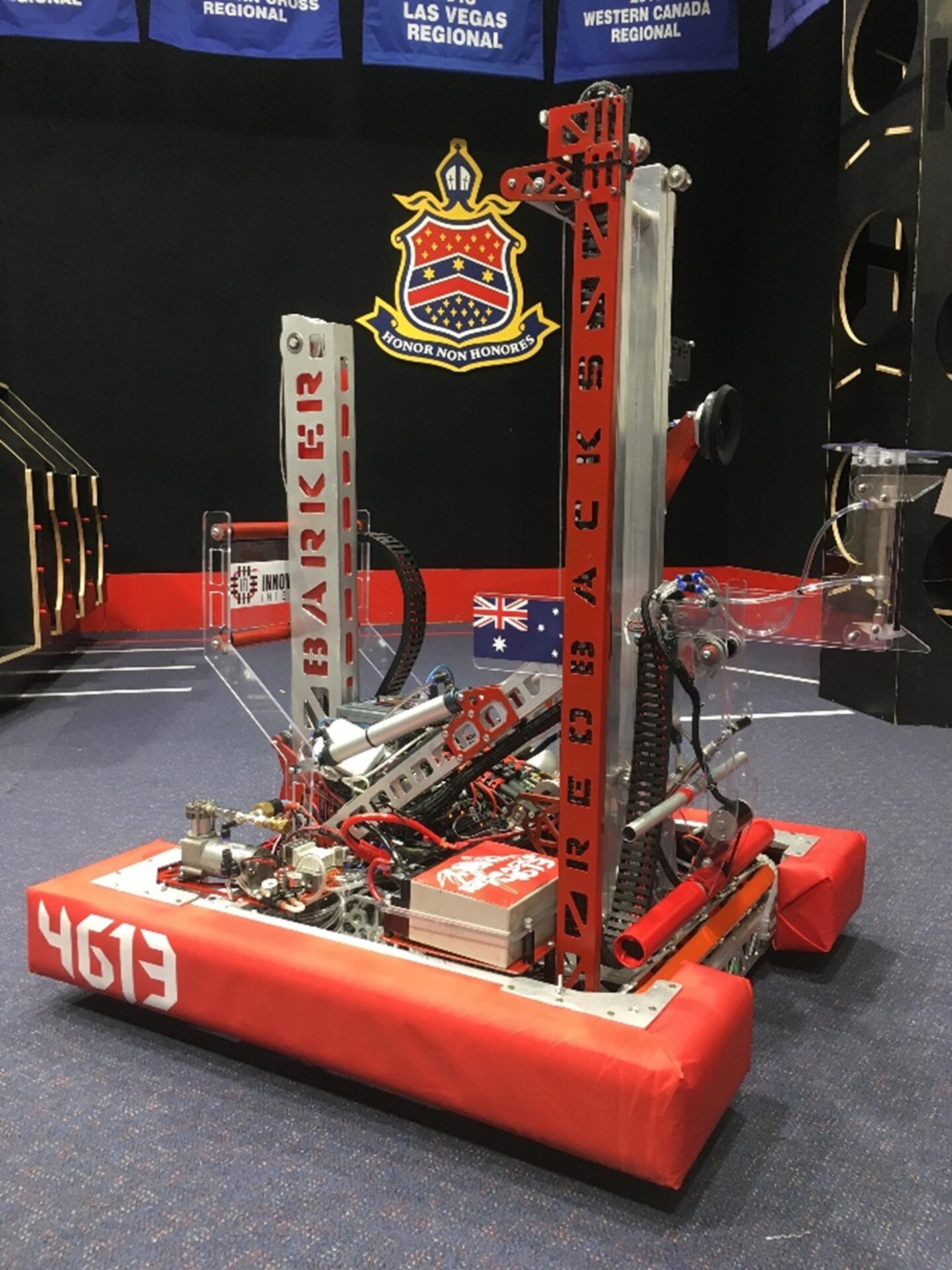
Four years building 54kg competition robots as part of FRC Team 4613, one of 5000+ teams globally. From 2017, drivetrain sub-team lead and robot operator. International championship division finalists in 2017. 12 blue banners across four years.

SolidWorks Fusion360 / MasterCAM CNC machining Drivetrain design Pneumatic gearboxes DC motor selection Lathe operation Workshop instruction
Watch 2017 robot

About FRC

The FIRST Robotics Competition is a global high school robotics program with over 5000 active teams. Each year, teams are given a new game — tasks have included shooting balls and objects at targets, precision pick-and-place, and autonomous navigation challenges. Teams have six weeks to design, build, and program a robot from scratch, then compete at regional events before the best teams advance to the international championship.

I competed for four years with Team 4613 from Barker College, Sydney. The experience of building real, competition-tested robots in high school was the direct foundation for my decision to pursue mechatronics engineering — and the skills I developed there have carried through into everything I've built since.

Add robot photo
e.g. frc-2017-robot.jpg
Add competition photo
e.g. frc-competition.jpg

FRC Team 4613 — 2017 robot at the Las Vegas Regional

2017 season — drivetrain lead & operator

In 2017 I took on the role of drivetrain sub-team lead as well as robot operator in competition. As lead, I was responsible for designing, manufacturing, and assembling the drivetrain from scratch — using tube-and-gusset construction CNC machined in SolidWorks and toolpathed with MasterCAM and Fusion360 CAM packages.

That year the team won four regional competitions across Australia, China, and the United States, qualifying us for the FIRST Championship held in Houston. At the international championship, competing against approximately 500 of the best teams in the world, we went on to be division finalists — one of the top four alliances in our division.

Years active
2016 – 2019
Team
FRC 4613 — Barker College
Blue banners
12 total
2017 regionals
4 wins (AU, China, US)
2017 championship
Division finalists (~500 teams)
Robot weight
54 kg
Role from 2017
Drivetrain lead + operator
CAD
SolidWorks, Fusion360
CAM
MasterCAM Router

Drivetrain design

FRC drivetrains are deceptively demanding — a robot weighing up to 54kg needs to accelerate fast, change direction instantly, and survive collisions while remaining reliable across multiple qualification and elimination matches. Getting the drivetrain wrong can end a season.

My approach used custom CNC-machined tube-and-gusset construction — aluminium box section and gusset plates designed in SolidWorks, toolpathed in MasterCAM and Fusion360, and cut on the school's CNC router. This method produces lightweight, stiff, and precisely dimensioned assemblies that are far stronger than welded or bolted-angle alternatives at the same weight.

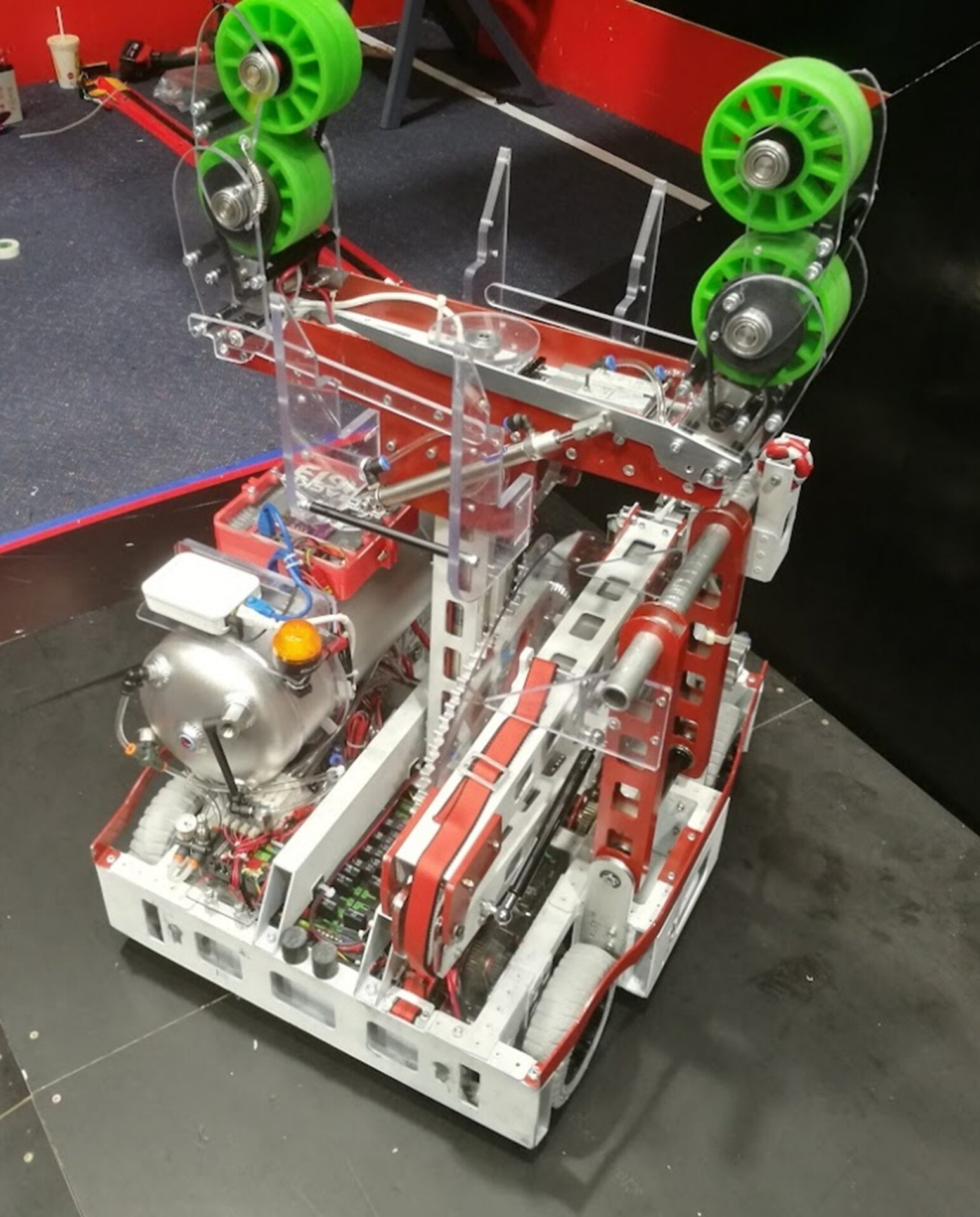
I designed a custom two-speed pneumatically actuated gearbox, allowing the robot to operate in a high-torque pushing mode for defence and a high-speed mode for open-field play. Gear ratio selection was driven by DC motor characteristic curves — plotting speed-torque curves for available FRC motors and selecting ratios to place peak power output at the target drive speed for each mode.

Add drivetrain CAD or photo
e.g. frc-drivetrain-cad.png
Add gearbox photo or CAD
e.g. frc-gearbox.jpg

Tube-and-gusset drivetrain and two-speed pneumatic gearbox

Manufacturing & machining

One of the most valuable parts of FRC was hands-on time with machine tools. Over four years I turned shafts, standoffs, spacers, and tube ends on the lathe, and became proficient with the CNC router for drivetrain components.

From 2017 I also ran workshops for newer team members, teaching safe lathe and CNC router operation. Teaching others how to use machine tools — explaining tolerances, feeds and speeds, fixturing, and safe practice — solidified my own understanding in ways that simply using the machines alone wouldn't have.

Add workshop / machining photo
e.g. frc-workshop.jpg

Team workshop — CNC machining and assembly during the six-week build season

Impact

FRC is where the engineering clicked for me. The combination of a hard deadline, real competition stakes, and a robot that either works or doesn't on the field taught me more about practical engineering judgement than anything else in my education. It's the reason I study mechatronics today.

The skills from those four years — mechanical design, CAM-driven machining, motor selection, and the ability to build and debug physical systems under pressure — have been directly applicable to every project I've worked on since.


Watch 2017 robot ← Back to projects